Wednesday, October 28, 2015

Home economics: II

One downer about being a graduate student for so long is that you become behind financially - not all of us - but many of us. So, by the time our friends are thinking about a second home or retirement, I'm thinking about living like I have a job. 

The home we live in was flooded in 1972 with Hurricane Agnes and water reached the second floor. We just removed all the paneling and random pieces of wood and were down to the studs. Then the electrician came and the inspector after that. Initially they said two weeks for the whole project but we're in the third week already and we just finished putting up the insulation last night - then immediately went to bed. Who knew insulation became so heavy after three days of installing it. 

The guys are at the house to put up the sheet rock and that is supposed to take three days from start to finish. Exciting just to start the next phase. 

Here's what it looks like with insulation (and you can still see mud on the studs). 


Monday, October 26, 2015

Pin oaks and birds

I remember seeing a bird talk that dissed pin oaks as being a trash species because it was not important to birds. This was in the southeast and pin/willow oaks are super abundant when you don't have fire. So, for some time, I just didn't like them.

But I've made a 180 on pin oaks and I realize they are hugely important to a number of birds in the northeast US (and probably elsewhere pin oak occurs) and probably host a number of invertebrates and other unpopular but crucial species. 

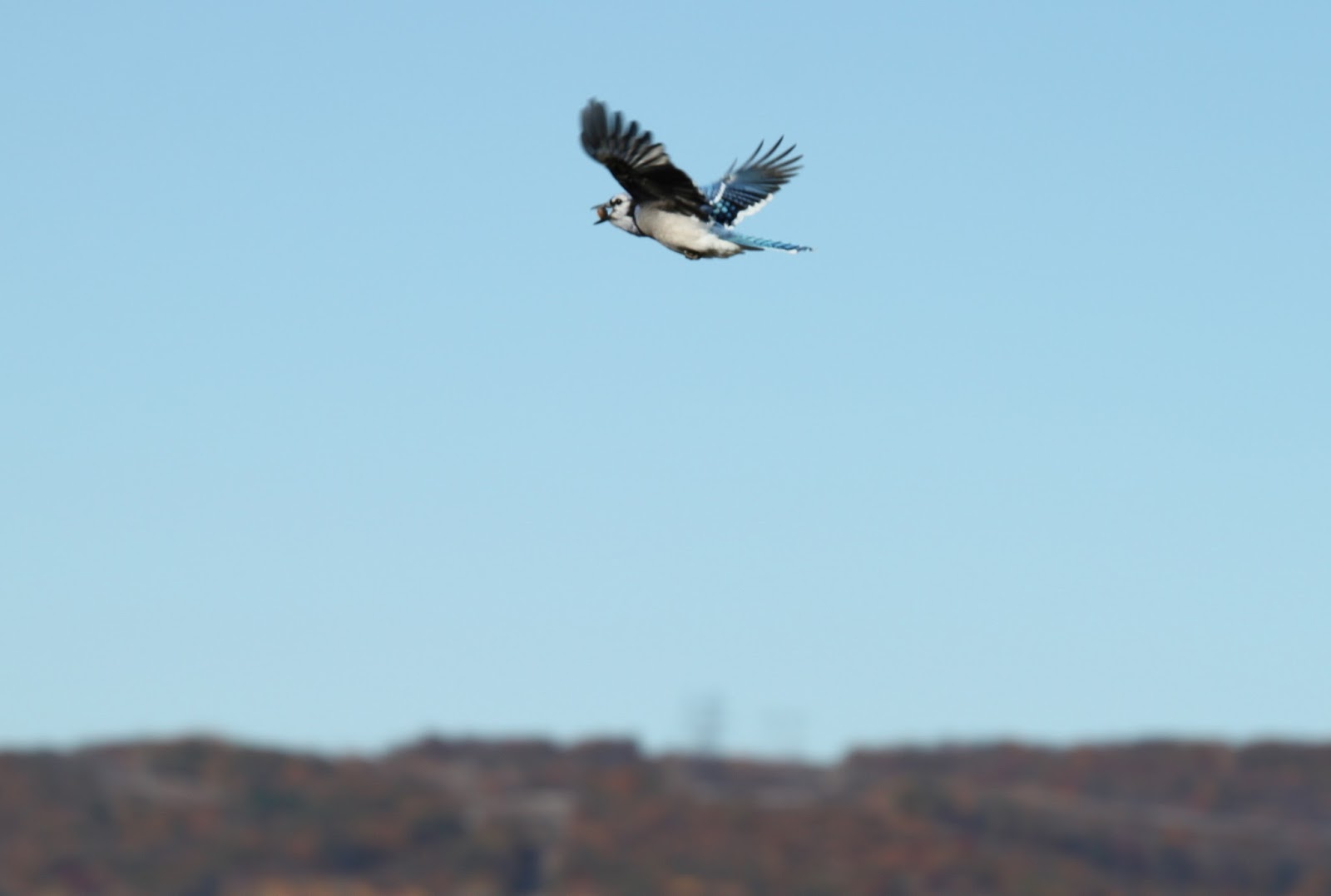
Today I spent an hour on the roof of Cohen and had three species come by. Blue Jays were there grabbing and flying off with several acorns in their crop. The one group of jays was coming from the other side of the Darte Center, which is 500 m away. They're flying over open areas where they could cache. Perplexing!

Crows ignored me and came by and ate a few acorns and took off. A titmouse looked be pounding an acorn to open it - not sure if it was successful. Last year there was a Red-bellied Woodpecker carrying off acorns. So pin oaks are not the fig trees of the tropics (which are known to be eaten by anything that can make up a tree) but they must be crucial to many birds.


Sunday, October 18, 2015

Archosaurs class at home

Yesterday [last week.. not sure why this didn't post] we had class at the house and the goal was to get kids to handle wild birds and show them how to get blood, make blood smears, turn blood smears into slides to look for blood parasites and observe different cell types, and get blood in capillary tubes that get centrifuged and we measure hematocrit. 

We ended up catching three house sparrows, a song sparrow, and two white-throated sparrows. Best part of the day was watching the kids I've trained work with the kids in the class. 


DNA barcoding: a road map

I went to a DNA barcoding meeting a few months ago and I've been more inspired to integrate this technique into my own research. I've been working on a food web project but I could also use this to identify parts of birds and the bits in a bird's diet. 

The first application would be to identify the invertebrates we've been catching for our grassland food web project. My idea was that we just needed to get a bit of tissue, amplify the DNA using PCR, send it off, get the sequence, ID the species, and DONE.

If I have gone through with this I could get our critters identified but with lower confidence and the work with be of little use for other researchers. A shame and near waste of work.

At the barcoding meeting, we met up with a Smithsonian scientist, Caroline, that agreed to come up and discuss with us barcoding issues. So, last week, she came up and gave a two day workshop for Ned and I and a number of students. It was incredibly enlightening. We found (many) issues with our protocols and we were pointed to a number of resources to help us with technical issues. More importantly, we were given a work flow that greatly expands on the flow I outlined above. The biggest missing piece is building a library of local organisms that are identified independently of DNA barcodes. These organisms you barcode and then use a reference. This seems a bit circular (and it is) but you can use your reference collection to identify bits of organisms or organisms in other stages, such as larvae and eggs. This sounds simple but it means getting specimens and organizing them. Organizing them. That is completely new to our lab and will be a challenge. But it's a challenge I'm willing to take up. One of the first things to do is to create an outline for the whole project and I'm doing it here. 

So, the workflow is this, get specimens (mostly, go out and collect insects), give them a number, get them identified, pin them in an organized way (presumably by order), bar code a small bit of them, link the barcode to the specimen. Now unknowns can either be ID'ed through the vouchers are barcoded. Everything is organized through BOLD Systems.

It was a hugely useful workshop and Caroline was a blast. She stayed at the Hillard House, which has an awesome breakfast menu. Students enjoyed the workshop as well and I hope they're inspired as well. 


Monday, October 12, 2015

Home economics

We're gutting our downstairs. This means tearing up the carpet, tearing down the panels, the plaster, and the plaster backing. It's mess. 

Our house was flooded in 1972 during Hurricane Agnes and you can still see mud from the flood on the supports. We're going to tweak the electric, insulate, sheet rock, and paint. Looking at a finish date of Thanksgiving. 


Friday, October 9, 2015

Music to write research papers to

I was introduced to the music of Marissa Monte in Brazil in the early 1990's. Great stuff. 

Thursday, October 8, 2015

A trip to the American Museum of Natural History: Part 3. Dinosaurs

Last Tuesday I spent the day at the American Museum of Natural History and had my Archosaur students in for some of it. Technically, I think we spent most of our time on the bus and if I'm going to do this again I think I'll take a van. I did this once and, except for the Holland Tunnel, it want very well. This was both expensive and time consuming. Live and learn. 

I posted on the type specimens and other birds and I ran through to get pictures of dinosaurs to integrate into lectures. Never enough time. 

Here are some of the better pictures. If I had a complaint about the museum it would be this - so much glare. So it goes. 

Acanthostega - nice intermediate between fish and amphibians

Allosaurus manuss

Archaeopteryx - close enough to dinosaurs!

Deinonychus manus - note the reduced number of digits and carpels

Deinonychus skull - built for ripping your face off

Diatryma - a bird, taller than me and three times as kick ass

Plateosaurus - an early quasi-bipedal sauropod - note the reduced outer digits
Prestosuchus - early archosaur

Gallimimus - very bird-like dinosaur
Temnospondyl - early amphibian
T. rex!