Nest cams are cool but they're not always heartwarming as I've shown here. Sometimes, the action can raise your heart rate.
Check out this video from Audubon.

Ecological research and life at mid-sized liberal arts university
Tuesday, August 2, 2016

Sunday, July 31, 2016
Diversity in cracks
I don't really enjoy the Wilkes-Barre cityscape except for some of the restaurants (Cafe Toscana is awesome). Nature seems to make inroads in spite of the city having any vision of green space that I'm aware of.
I was impressed by a meter x meter plot behind the Wilkes parking garage. There must have been a dozen plant species crammed into the spot and a house finch flew in while I was admiring this patch.
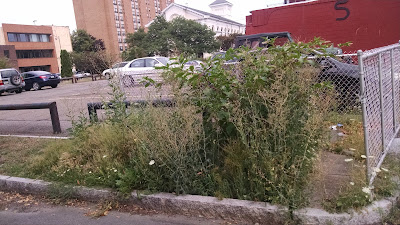
I was impressed by a meter x meter plot behind the Wilkes parking garage. There must have been a dozen plant species crammed into the spot and a house finch flew in while I was admiring this patch.

Big birds of North America
In a new Bulletin of the American Museum of Natural History there is an article on a newly discovered fossil from Wyoming of a paleognath - the same group that contains ostriches, emus, rheas, and tinamous. The specimen is about 50 million years old - post dinosaur apocalypse and pre Pleistocene.
I love the idea of paleognaths in the neighborhood. I wonder though what ecology would look like if we were around then. Would be still have our rules (Bolgers, latitude and species diversity, etc).
I love the idea of paleognaths in the neighborhood. I wonder though what ecology would look like if we were around then. Would be still have our rules (Bolgers, latitude and species diversity, etc).
Tuesday, July 26, 2016
WEBS 2.0
WEBS (Women Empowered By Science) is one of the great programs that comes out of Wilkes University. This brings middle school girls on campus to do activities with faculty or their lab members with the goal of building interest in science. Last year a news crew from WNEP came did a segment on our efforts.
One of my worries is that there's a gap between middle school and college where they might lose interest. To address this I started taking high school girls into the lab and I called it WEBS 2.0. This year I had two high school juniors and they worked on our barcoding project.
Today was their last day and they asked the best question they could have asked:
"Can we do this next year?"
One of my worries is that there's a gap between middle school and college where they might lose interest. To address this I started taking high school girls into the lab and I called it WEBS 2.0. This year I had two high school juniors and they worked on our barcoding project.
Today was their last day and they asked the best question they could have asked:
"Can we do this next year?"
Sunday, July 24, 2016
Planting pollinator-friendly plants - baby steps
I find campus plants to be exceedingly boring and just reflect what's available at the landscapers. So I'm going to add a little bit here and there.
This is my first addition. On the east side of the Cohen Science Center I added joe-pye weed (Eutrochium purpureum) a few days ago and three smaller common milkweeds (Asclepias syriaca). In the picture, roses are in the background.
Up in the greenhouse, I have about twenty more plants growing and when they get 12" (totally arbitrary), I'll plant them outside.

Thursday, July 21, 2016
Red squirrel predation on wood thrush nest
We've been monitoring a dozen Wood Thrush nests this summer and about half have failed. We didn't have cameras on them until recently so we weren't sure why they failed. Yesterday, I finally checked out an SD card from a camera that was on a nest in Schnecksville, PA - an area of farmland.
One photo shows a red squirrel pulling a young fledgling out of the nest. What's remarkable is that red squirrels are largely restricted to pines. So what's this guy doing?
This nest was doubly damned. It also had a cowbird egg. So even if the squirrel didn't consume the nestlings the cowbird would likely kick out all the nestlings.

One photo shows a red squirrel pulling a young fledgling out of the nest. What's remarkable is that red squirrels are largely restricted to pines. So what's this guy doing?
This nest was doubly damned. It also had a cowbird egg. So even if the squirrel didn't consume the nestlings the cowbird would likely kick out all the nestlings.

Friday, July 15, 2016
Plant babies
Back in May I was just getting started with the persimmon and milkweed babies. They've been growing up!
The persimmons are slow growing but progressing nicely and the tallest is over three feet high but most are about a foot. The swamp milkweed is even more variable: the tallest is a foot but many are a few centimeters (yes I'm using English and metric units). They seem to refuse to grow straight but that's probably my fault.
The new addition to the family are 24 paw paw (Asimina triloba) seeds that I just planted this morning.
The persimmons are slow growing but progressing nicely and the tallest is over three feet high but most are about a foot. The swamp milkweed is even more variable: the tallest is a foot but many are a few centimeters (yes I'm using English and metric units). They seem to refuse to grow straight but that's probably my fault.
The new addition to the family are 24 paw paw (Asimina triloba) seeds that I just planted this morning.
 |
| Paw paw seeds down in the dirt |
 |
| Persimmon babies |
 |
| Milkweed babies and toddlers |
 |
| Milkweed toddlers |
Subscribe to:
Posts (Atom)