The latest Ornithological Societies of North America newsletter had an obituary of Luc Hoffman.
"a member of AOU and Honorary Fellow since 2004, COS since 1952, WB since 1983 and WOS since 1955, passed away at the age of 93 on 21 July 2016 at his home in the Camargue wetlands of southeastern France. He served as director of Wetlands International, vice-president of IUCN and BirdLife. He was the driving force behind the Ramsar Convention on Wetlands and was also a co-founder of World Wildlife Fund. His love for birds led him to secure incredible gains for conservation."
His Wikipedia entry is here https://en.wikipedia.org/wiki/Luc_Hoffmann
His institute is here http://luchoffmanninstitute.org/

Ecological research and life at mid-sized liberal arts university
Monday, October 10, 2016

Tuesday, September 27, 2016
A post! Life in the greenhouse
As it happens every semester, I get swamped. But I haven't balanced the busy with the relaxing and trying to remedy that.
First is spending time with plants. Easy. Go up in the greenhouse. The second will be to get out in the field. Let's see how that goes.
Today, I was up to check on a few projects. All are going really well.


First is spending time with plants. Easy. Go up in the greenhouse. The second will be to get out in the field. Let's see how that goes.
Today, I was up to check on a few projects. All are going really well.

Competition experiment for Ecology. Students plant seeds in different concentrations and combinations and will measure biomass at the end

Persimmon. These were seeds this spring. Looking awesome
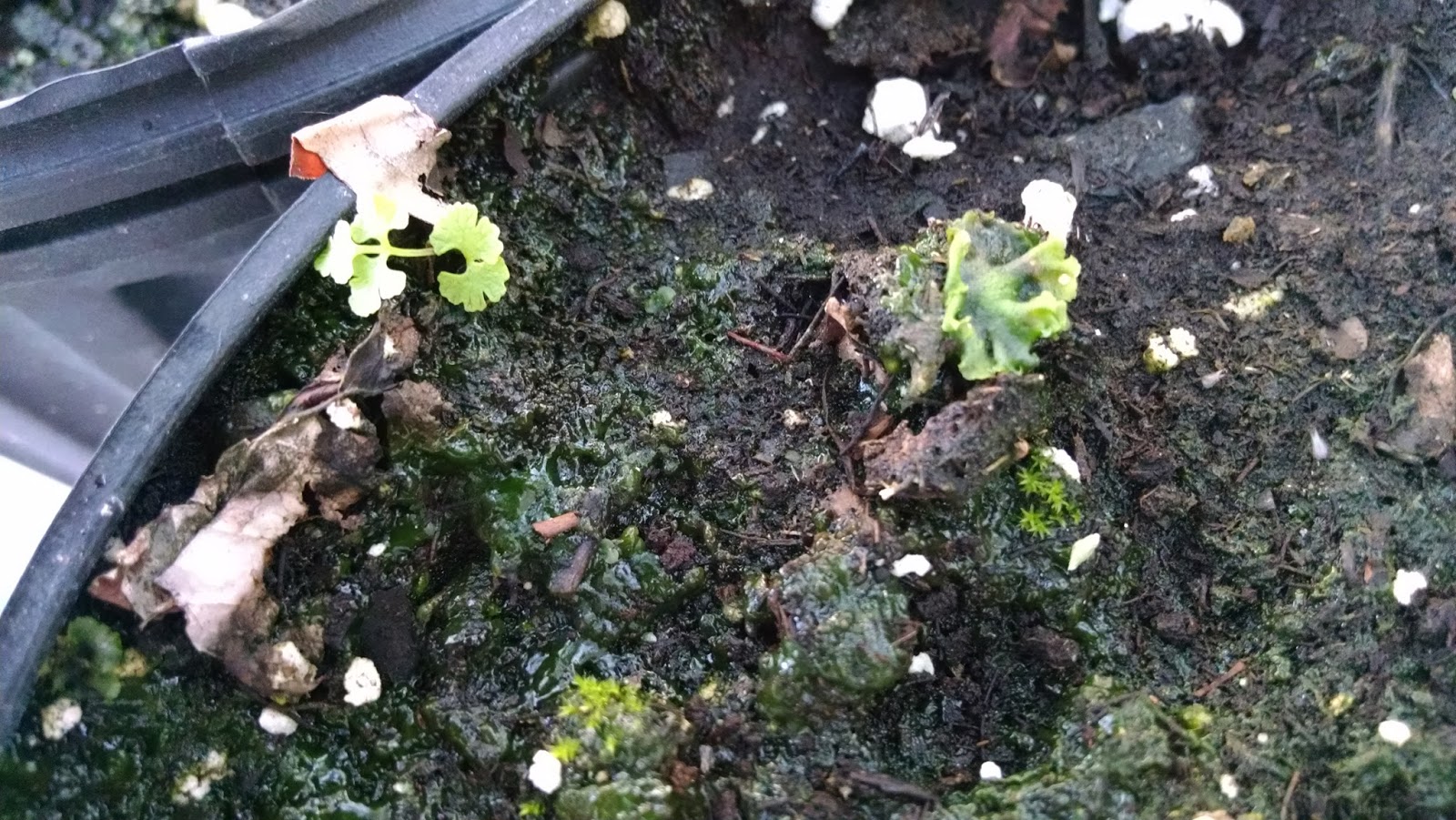
Four groups of photosynthetic plants here. Small fern in the top left, liverwort in the top right, there's a moss between the two and down a few cm, then there's an algal film throughout.

Pawpaw seedlings. These just germinated and they've been sitting in damp soil for weeks. Super excited about these guys. I've never seen a pawpaw in the wild.
Wednesday, September 21, 2016
Meow meow plague meow
The allusion to Mr. Rogers will only be understandable to those with some gray - like it or not.
Here's a link to a story about a cat with plague in Colorado. It's out there simmering.
http://www.thedenverchannel.com/news/local-news/cat-contracts-plague-in-jefferson-county
Here's a link to a story about a cat with plague in Colorado. It's out there simmering.
http://www.thedenverchannel.com/news/local-news/cat-contracts-plague-in-jefferson-county
Tuesday, September 13, 2016
Turtlehead flowers
Turtlehead flower (Chelone glabra) is one of my favorite native plants and I had to get one when I came across individuals for sale (Edge of the Woods has them in Oresville, PA).
When I was walking out to my truck I noticed a bumblebee visiting the plant and it disappeared! Then I noticed a leg sticking out.
Two petals of the corolla close down like the jaws of an alligator. The bumblebee is large enough that it has the muscle to lift the top and crawl inside. This is just another mechanism that plants use to exclude some pollinators and increase the probability of having a narrower pool of pollinators. This increases the probability that pollen goes from turtlehead to turtlehead. Other mechanisms include corolla length (long corollas are pollinated by long tongued insects, colors, timing of flowering, and even deception). Cool stuff.
 |
| There's a bumblebee in the front flower and you can see one of her black legs sticking out the left side |
 |
| Bee leaving |
Monday, September 5, 2016
Jacob's Property wanderings
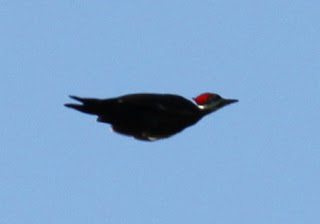
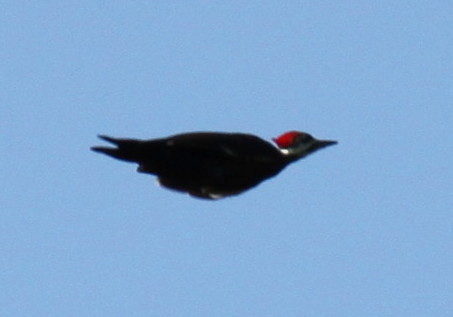
Explored Jacob's property in Buck Township, PA. Was there for two hours and picked Tufted Titmouse, Black-capped Chickadee, Eastern Phoebe, Olive-Sided Flycatcher (my first in many years), Pileated Woodpecker, Downy Woodpecker, Northern Flicker, American Crow, Blue Jay, Red-breasted Nuthatch (another goodie), White-breasted Nuthatch, Song Sparrow, Common Yellowthroat, Black-throated Blue Warbler, Blue-headed Warbler, mystery thrush. Swung by the pipeline and the grasses they planted are coming up nicely.
It was also a great day for fungi!
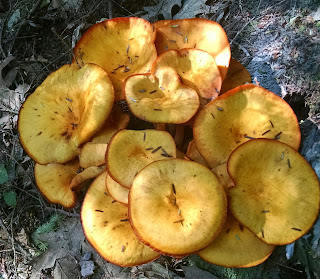


It was also a great day for fungi!


 |
| Coyotes dispersing seeds to the pipeline right-of-way |

 |
| Flypoison |

 |
| Bottle Gentian |


Saturday, August 27, 2016
Alabama for Darwin, historically speaking
I haven't read this article but I want to post it so I go back and read it.
Alabama fossil's role in the development of Darwin's theory.
Alabama fossil's role in the development of Darwin's theory.
Undergrad projects for the ecology course
If I think back to my own undergrad and the aspects of courses that excited me the most. There were only a few lecturers I found to be engaging. At Rutgers, the late Ted Stiles was certainly one - his lectures in Vertebrate Zoology were exactly what I was interested in. At Southeastern, I loved Gary Shaffer's biostats lectures.
Maybe my memory is failing me but most labs didn't excite me. The exception was Marine Animal Ecology lab. There were only a handful of us and they combined this course with a graduate level course. The highlight of this course for me was working with the graduate students on their projects. In fact, it was this interaction that led me to going to graduate school.
I'm hoping that a more involved lab will get students more excited (is that the right word?) about ecology and have greater satisfaction than a bunch of smaller exercises. We'll see.
Here the draft statement on the projects from my syllabus. I think these are reasonable and students should get interesting results. Maybe the phrase I'm looking for is "intellectual satisfaction." That won't be on any university brochures but that's exactly what I hope students experience.
Maybe my memory is failing me but most labs didn't excite me. The exception was Marine Animal Ecology lab. There were only a handful of us and they combined this course with a graduate level course. The highlight of this course for me was working with the graduate students on their projects. In fact, it was this interaction that led me to going to graduate school.
I'm hoping that a more involved lab will get students more excited (is that the right word?) about ecology and have greater satisfaction than a bunch of smaller exercises. We'll see.
Here the draft statement on the projects from my syllabus. I think these are reasonable and students should get interesting results. Maybe the phrase I'm looking for is "intellectual satisfaction." That won't be on any university brochures but that's exactly what I hope students experience.
- Food web at Nescopeck State Park
- Students will observe and capture insects on plants that are either consuming or pollinating them. Insects and plants will be identified to species. At least 100 interactions are to be documented.
- Insectivory and Frugivory and Urbanization
- Students will use clay caterpillars and clay berries to investigate how ecosystem services change across urban-rural gradients. Caterpillars will be set up at nine sites (3 urban, 3 suburban, 3 rural). Fruit clusters will be located at the same sites.
- Decomposition and urbanization
- Students will use tea bags and logs to determine decomposition rates along urban rural gradients. Clusters of 5 bags and 5 logs at 15 sites will be used.
- Deer density and urbanization
- Students will use game cameras to quantify deer densities across an urban-rural gradient. Fifteen cameras will be used for three weeks and checked weekly.
Subscribe to:
Posts (Atom)